Thursday, March 20, 2014

Free Website Tests You Can Do Right Now

We've hosted several free website critique webinars on PhotoLovecat.com, based on the best practices that we've identified in our industry and across websites in general.  Since we don't have the time to test everyone's websites, here are some resources to help you get feedback on your own website right now!

UserTesting - Peek
http://peek.usertesting.com
UserTesting offers a free "peek" of their services in a 5 minute recorded video of a user clicking around your specified website and sharing what they love and don't love about how your site navigates as well as the information available on it.  This is a great way to see how an objective general user interacts with your navigation menus, contact form, and online content so that you can see what fixes you might be able to address in order to improve your website for visitors.
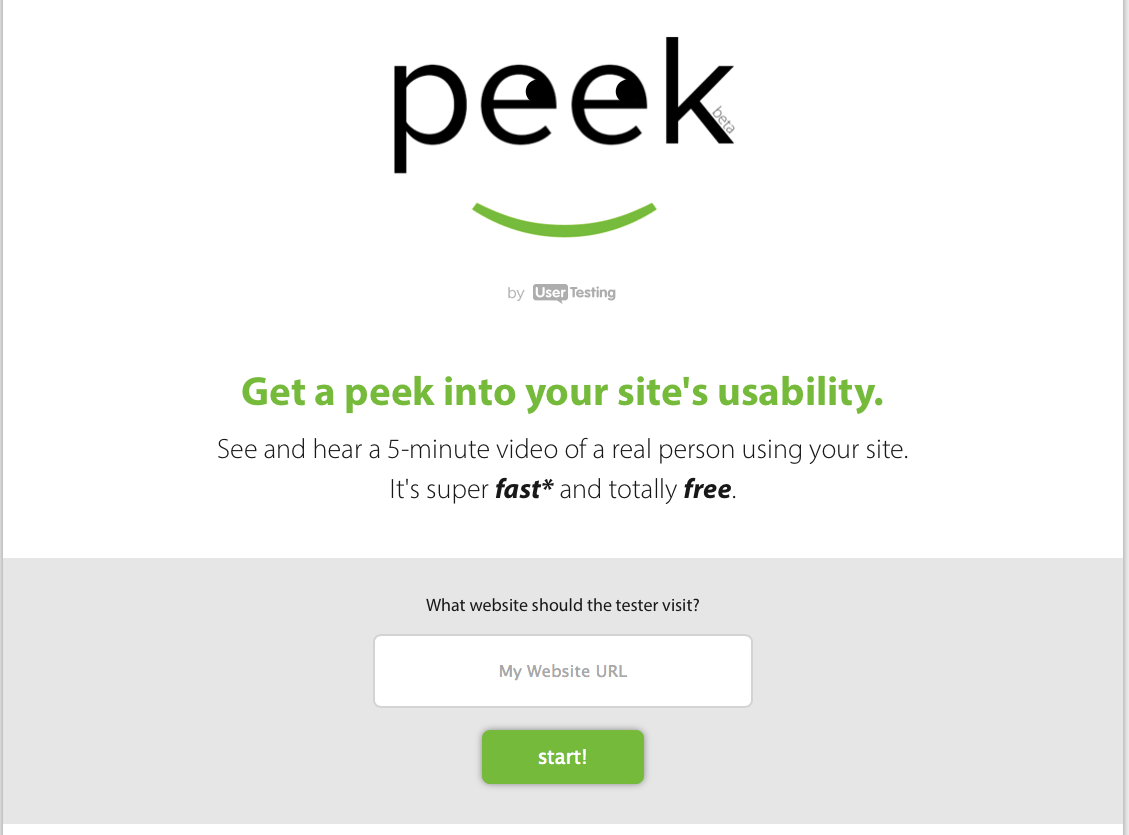
peek usertesting


HubSpot - Marketing Grader
https://marketing.grader.com
HubSpot is one of my favorite free services for analyzing your site's inbound marketing strategies with SEO, Lead Generation links, Social Media reach, and other online markers of presence and accessibility.  The software is fully automated, so it's less high-touch, but it approaches your website from a similar perspective as a content web crawler like Google would. This is a great way to see what social media and marketing strategies you aren't currently implementing that you can improve upon.


Pingdom - Speed Test
http://tools.pingdom.com
Pingdom focuses on improving website speeds by identifying slow loading materials on a page as well as what loads first and last.  One of the factors in how your website ranks in search results is how fast your content can make it to the search engines, so running a speed test can help you identify the images or code that need to be cleaned up for faster loading.  Pingdom also gives you a sample of how your website stacks up against other sites that are being compared so that you know where you stand in loading times.

Try each test now and see what you can work on!  Have you seen any other awesome website tests people should run their website through?  Share in the comments!


Anne Ruthmann is an editorial & event photographer in New York City. She spent 10 years practicing marketing & management in corporate and non-profit businesses before pursuing her passion for photography in 2004 as an independent small business.  She loves helping others find creative and smart solutions to business problems.  Stay in touch on Twitter or Facebook.

Monday, March 17, 2014

What If You Lost Everything?

Have you ever seen the movie "The Impossible"?  It's a true story in which over 150,000 people were wiped out by tsunami. Man, nothing like an end-of-the-world scenario to make you appreciate life, right?!  It inspired me to have a conversation with my spouse about what our strategy and recovery plan would be if something like that happened to us, or heaven forbid, I was wiped from the earth while there were still clients who needed to be taken care of.  Thankfully, I already know that my high resolution images and business contracts with relevant client contact info have been backed up in an online cloud with Pictage and ShootQ, so I'm not really worried about something like my hard drives being damaged or clients being left high and dry.

Now, let's forget major natural disaster scenarios and just consider worst-case scenarios in every day life.  What if all of your equipment was stolen?  Does each job you do provide enough cash to cover renting the equipment you need until you could get replacements?  Do you have insurance that would make it easy to buy new equipment?  Do you have enough savings built up if your insurance reimbursement didn't come in for months?

Last St. Patrick's Day I also acquired a sprained ankle on my last day in a trip to Ireland (I guess my St Patty's luck was that it wasn't broken!)  Fortunately, I had enough recovery time built in after my trip that I didn't have to cancel any jobs, but I also knew that I had people I could call to replace me if I needed them.  Do you have people who can fill in for you and provide the same level of quality and professionalism if you can't make it to a job you've been contracted to do?  Are you connected to a professional network of highly qualified people?  Do you have disability insurance if you're permanently injured and need time and money to pay your bills while you figure out a different business model?

Those who are prepared for disaster are the "lucky" ones because they can bounce back much more quickly and continue running a business after something dramatic happens.  If you didn't back up everything or have systems in place to do a job regardless of what happens, that's on you, not mother nature.  The biggest difference between being a creative business owner and a hobbyist is being prepared for the unexpected, and making sure clients will be taken care of whether you can be there or not.  What are you going to do this week to make sure your business is safer in the years ahead?  If you don't do it NOW, when are you going to have time to do it later... or when it's too late?

Anne Ruthmann is an editorial & event photographer in New York City. She spent 10 years practicing marketing & management in corporate and non-profit businesses before pursuing her passion for photography in 2004 as an independent small business.  She loves helping others find creative and smart solutions to business problems.  Stay in touch on Twitter or Facebook.

Tuesday, March 11, 2014

Why Hiding Pricing Only Hurts You

What was the last major purchase you made in which you couldn't easily find a price before talking to a sales person about the product?

A home?  Real estate listings online generally list home value before you attend an open house.

A car?  Sales prices are generally listed online before you need to walk into a store.

A painting?  Art sales prices are generally listed on a sales sheet in the gallery which you can pick up before viewing the work.

A TV?  Airfare?  Vacation Package?  Rug?  Furniture?  Pair of shoes?  Phone?  Jeans?  Haircut?

…. yeah, I can't think of anything either…. so why do photographers and some other creatives hide their pricing information?

Hiding pricing hurts you in several ways:
  • clients may assume a price above their budget based on not seeing a price at all and just not contact you about their project
  • clients may assume a price in their budget based on other pricing they've seen elsewhere and assume you're a budget service only to contact you and find out that you aren't in their budget at all, which wastes both your time and the client's time
  • clients and event planners may just be doing online research and not know how to value your work against other work they're considering, and thus they throw you out of their pool entirely because they don't have enough info
  • by not providing a value for your work up front, you don't give clients advance notice about what they should plan to spend with you, which would help them prepare their finances up front and be more ready to book you on the spot before getting in touch
You don't need to give out your entire price list, but you should at least give a starting price or a price range and inform clients if you expect to prepare a custom collection for them based on their needs.  Not only will it save you and your clients a lot of headache and heartache, it will also present your business as honest, straightforward, and trustworthy - which are all desired traits for anyone looking making an investment in a quality service.

Check out Christine's previous post on this same topic for more thoughts on providing pricing: http://photolovecat.blogspot.co.uk/2009/03/on-sharing-pricing-up-front.html

Anne Ruthmann is an editorial & event photographer in New York City. She spent 10 years practicing marketing & management in corporate and non-profit businesses before pursuing her passion for photography in 2004 as an independent small business.  She loves helping others find creative and smart solutions to business problems.  Stay in touch on Twitter or Facebook.

Tuesday, March 4, 2014

The Case Against Being Too Focused

From my experience in marketing, I'm very familiar with the idea of something being more powerful and more marketable when it's highly focused on its audience, product, branding, and method of delivery.  However, from my experience in finance, I also know that it's much more financially stable to be highly diversified across many different sectors in order to fight off a feast or famine cycle of income.  So when it comes to running a business, there's a case to be made for both arguments of being highly specialized, and for being very diversified.  They key is knowing what works best for YOU, because in order for you to thrive in any direction, you need to work in a way that suits you best.

As for me?  I thrive on diversity and change, and I used to think this was a bad thing because everyone around me was trying to get me to choose JUST ONE THING.  Just the thought of doing only one thing forever was stifling, it made me want to crawl out of my skin.  I tried being a music teacher in a public school where the setting was the same every day, I'd have to work on the same pieces of music with the same group of students every week, and see the same people who had the same problems over and over again.  I got so bored with the overall environment of complacency that I started doing photography on the side, and because I was THRIVING in working with different people and subjects all the time in photography, I was able to go full time into photography after only one year.  I did occasionally return to schools to teach a workshop here and there, or to work as part of a teaching artist program, because I still love teaching and helping students dig into their own creativity, but I found a way to do it that wasn't stifling for me- a way that gave me the variety and freedom that help me thrive.  In turn, when I was feeling stuck in photography, having this other creative teaching outlet then helped fuel my love and creativity in photography again.

While I absolutely love shooting weddings, the every-weekend-in-the-summer-routine was starting to wear on me after 7 years and I wanted more weekends to enjoy spending time with friends and family. So, I started exploring other types of photography work that I could shoot during the week, which allowed me to take fewer weddings and enjoy more weekends, but also really love and appreciate each wedding I was shooting again because it wasn't every weekend.  I started shooting entrepreneur portraits, images for website companies, events for a university, real estate, and more.  While some other photographers around me, who were only focused on weddings, started feeling like their business was slipping away from them, I was thriving on the variety of work that I had and wasn't feeling as affected by changes in the market.  I was still creating work I loved, and doing it in a way that I enjoyed, but I was no longer confined to one subject or working style.

Some of my friends, who had heavily invested in their narrowly focused branding and website design were really starting to feel the pinch that came from focusing so heavily on one market and one client that just didn't seem to exist in the numbers they were hoping for, and that narrow focus was actually hurting them in some ways, especially because they felt like they couldn't expand until they'd worked out an entirely new set of branding.  Amazingly, I didn't even have a portfolio of work for all of these new jobs I was taking, they were all just coming based on word of mouth connections and networking that I had been doing along the way (which is also a lesson about not waiting for your website to be finished or perfect before putting yourself out there.)  Not everyone thrives on having variety in what they photograph or in how they work, but even for those who love to be highly focused, there are ways to expand a financial model without changing subject matter.

I have several photographer friends who focus narrowly on pet photography, but find that the pet owner market, which is willing to spend hundreds each month on extras for their pet, isn't always interested in paying for a photo shoot of their pet.  In this case, they can still focus narrowly on the subject matter of pets, but expand the possibilities of who might be interested in buying the photography, and expand the product lines and how they are sold.  Instead of focusing on the sales of individual shoots, creating a themed book that can be widely sold and distributed while also raising money for a charity, or pitching a series of images for an ad campaign for different types of pet products. Perhaps one of the most notable pet photographers, William Wegman, turned his pet work into gallery art, a book, calendars, and cards that could scale his work and be widely distributed to a larger audience, which also led to additional commercial work.  While his subject matter and control over his work remained highly focused, his sales model was expansive and allowed for many different types of purchasing.

So, if you're struggling with the idea of being told to just do ONE thing, I'm here to tell you that you don't really have to.  If you need variety to thrive, embrace it and own it, don't run from it or feel bad about it.  No need to hide your variety or push it aside in favor of something else.  Stand up for your unique way of working- not everyone has the talents that you do, or the ability to work in multiple ways!  Do the work you love and more of what you love will come your way.  Likewise, if you need focus in order to thrive, just focus and find more ways to share your highly targeted focus.  There is no one way that's right or wrong, only what's best for you.

Need more support in bringing your many different interests together in a career?  Check out this book: Refuse to Choose!: Use All of Your Interests, Passions, and Hobbies to Create the Life and Career of Your Dreams

Anne Ruthmann is an editorial & event photographer in New York City. She spent 10 years practicing marketing & management in corporate and non-profit businesses before pursuing her passion for photography in 2004 as an independent small business.  She loves helping others find creative and smart solutions to business problems.  Stay in touch on Twitter or Facebook.

Tuesday, February 25, 2014

Why is Everyone Else Doing Better?

There's a reason they call it March Madness, and it has nothing to do with the NBA- unless we're talking about "Not Being Already-booked."  It's that point when photographers have spent far too much time online- fielding emails for inquiries of people who haven't cleared their winter brain fog, going over last year's work and deciding if they should rebrand or create an entirely new website AGAIN, and spending too much time on social media or forums where they can size-up and compare themselves to others.  Whether we think we're better or worse than what anyone else has going on, the danger is in the comparison itself, and taking the attention off of our own intentions and focusing it on others instead of ourselves.

This is also the time of year I end up doing more consulting with people who want to get ahead by putting plans in place now before it gets busy, and one of the things I hear over and over again is people saying something to the effect of, "this person is doing SO well, they're sharing new work ALL the time."  Of course, they rarely seem to stop and consider that perhaps that work isn't paid work, or perhaps it's actually recycled old work from last year that's just now getting shared, or any other combination of things that appear to be one thing when maybe they're actually something else.

You see, the illusion created is that other people appear busy while you're just hanging out online, and regardless of what's actually going on behind the scenes.  You just fell for an illusion, or even worse- compared yourself to that illusion like looking at a photoshopped magazine cover model.  If you were busy implementing your own plans and getting down to work on your craft, you'd have no time to dilly dally with comparisons or other people's illusions.  If you were shooting, or out networking, or creating your next newsletter, or developing your next pitch for a special sales event, you wouldn't be on facebook or twitter watching the world go by your browser window.

The reality is that you're not getting ahead because you aren't creating work for yourself, instead, you're waiting for work to walk in the door.  If you aren't creating work for yourself, than you also aren't sharing work to promote yourself, leaving you even more time to spend looking at what everyone is doing rather than creating your own buzz-worthy projects and sharable shoots.

See where I'm going?  Do I even need to finish?

If what you want is to get ahead, you have to take some action and create something that's in line with what you love and what you want to attract.  Have fun with it, go big, get crazy, be outrageous, try things you'd never try with a paying client, answer only to your own sensibilities- and in doing that, you may create something entirely unique and buzz worthy.  Share it unabashedly like it's your newborn child.  Share it in as many ways as you can and leverage that work to attract new work.  Don't stop there, rinse and repeat.  Make it a practice that when you don't have work from others, you create work for yourself, so that you can always keep moving ahead to your next great client.  Start your process now by telling us in the comments what your next awesome project will be!


Anne Ruthmann is an editorial & event photographer in New York City. She spent 10 years practicing marketing & management in corporate and non-profit businesses before pursuing her passion for photography in 2004 as an independent small business.  She loves helping others find creative and smart solutions to business problems.  Stay in touch on Twitter or Facebook.