Showing posts with label website. Show all posts

Tuesday, January 29, 2019

PhotoShelter Review from a Commercial Photographer

Before deciding to use PhotoShelter in 2016 for my Commercial Architecture & Interior Design Photography business in New York City, I had been a long-time user of Pictage for my Professional Wedding & Portrait Photography business while living in Massachusetts, Indiana, and Michigan from 2005-2015.  Before I had settled on either of these solutions for my photography business, I had investigated a lot of other solutions first.  I mention this just to provide some context and background for my time and experience with professional image vendors in the photography industry.

BEFORE USING PHOTOSHELTER:

When Pictage closed in 2015, I had to scramble to find a way to transfer my 10 years of professional image archives out of that solution and into a new solution.  The quickest answer that I could manage online at the time was to FTP all client image archives from Pictage into Dropbox.  This wasn't the best solution, but it was the solution I had time to manage, along with the help of a virtual assistant that I had hired to make sure the task was completed properly.

My NYC Real Estate, Rental, Architecture, & Interior Design Photography clients had very different needs than my Wedding & Portrait Clients.  Wedding & Portrait clients needed some print fulfillment options for greeting cards, wall prints, framing, sharing images with guests, selecting how private their images would be based on who was looking at them, and album proofing, printing, and binding to help them pull together family and wedding albums.  Commercial clients needed no professional print fulfillment from me, just digital solutions.

Commercial & Residential Real Estate, Rental, Architecture, & Interior Design Photography clients needed to be able to share the images with multiple vendors, have a variety of image licensing options, have a variety of downloading sizes and file types (TIF, JPG, PDF), and have a sense of privacy and control over who could see and access the images. I also needed to be able to store some RAW files to collaborate with retouchers and post-production specialists who were based in other states or cities and give them access to download those files easily.  The total file size needs were not in giga-bytes, but in tera-bytes, so I needed an unlimited image storage solution that could deliver fast uploads and downloads.

In my scramble to find an interim solution, I found that Dropbox was awful for images.  Color accuracy was atrocious, which ruined all the careful white balancing I'd done for commercial architecture and interior clients who spent hours picking out the right colors for their projects and relied on me to nail that color accuracy in photos.  The colors were fine after they were downloaded, or if they were being viewed offline, but online- terrible.  I almost lost some clients over this issue, so I really needed to find another solution other than Dropbox for my commercial clients.

I shopped around comparing various industry photo hosting and storage vendors, and found that many of them were mainly focused on catering to the needs of wedding & portrait photographers.  Which is, after all, one of the largest photography industry markets, so I get it.  Many fewer businesses need professional photography than number of people getting married or having families.

MY FIRST IMPRESSION OF PHOTOSHELTER:

Photoshelter appeared somewhat small in terms of photography market share of users.  They had been slowly and steadily building their platform and it appeared that they were focusing on users that came out of the New York market of clients.  Photojournalists, Fine Art Photographers, and Commercial Photographers dominate the New York photography landscape.  Professional Real Estate and Rental Photography has only exploded in the last 5 years.  Interior Design & Architecture will always remain a very small niche market of photography mainly focused in the top cities of the world.  So the question came down to whether or not Photoshelter had everything I needed as a commercial photographer?  The following is a run-down of what I've found to be good and what can be improved after using PhotoShelter for a couple years.

UNLIMITED STORAGE: *****
Initially, they didn't have an unlimited storage option, so it was tough for me to sign up right away, knowing that I would have limits on the number of files I'd be able to manage on their platform without incurring extra upcharge fees that might be unpredictable.  Luckily, they started offering an unlimited option under $50/mo shortly after I started considering them, which made it much easier for me to bring all of my commercial image needs onto their servers.  I had been paying Pictage $100/mo for unlimited image proofing & storage, but they also provided many other services I needed as well.  I had been paying Dropbox $50/mo for shitty image proofing & storage of only 500GB, so PhotoShelter was a much better choice simply on the unlimited storage to cost ratio and the fact that I could integrate several other things into the same online service.

VARIETY OF IMAGE FILE TYPES: *****
Since I provide different types of image files to different types of clients, I really needed a solution that could handle a variety of image files from RAW to TIF to JPG... and even PDF... and I was happy to find that PhotoShelter was able to manage all of these file types and provide color-accurate online previews of the files no matter what type they were being stored and offered in.  This made my clients happy to see such great color accuracy and quality detail on their images, and it made me happy to not have to explain to every new client that the color and quality would be better on download.  My clients purchased more images because they looked great- which is super important when you enter a realm where images can be licensed one by one for hundreds or thousands of dollars.

PRIVACY & CONTROL OPTIONS: *****
One of the other important factors in commercial work was being able to control who could access the images, who could download the images, what file size and type they could download, as well as how long they would have access to those downloads.  I was happy to see that PhotoShelter had built-in options for offering different file sizes from one original download, as well as giving me the ability to limit who would be able to download based on email or password, and how long they would be able to download, based on expiration date or a one-time download link that lasted a few days.

PORTFOLIO MANAGEMENT: *****
I wasn't really expecting to get a portfolio included with my online image hosting & proofing provider, but with PhotoShelter I did, and it was so easy to drag and drop images from the unlisted proofing side of the website to the listed and visible website portfolio side of the website.  There are also some built-in image SEO tools, watermarking options, and website layouts that make setting up and revising your portfolio as easy as just dragging and dropping from your latest projects.

COMMISSIONS & ONLINE SALES: ***
For photographers who want to keep their money where their images are, PhotoShelter is OK, but it takes a bigger cut of your sales than other solutions.  So, I had to make a decision about whether I was going to run my client invoices and sales through PhotoShelter or continue using other options that I'd already started using after Pictage closed.  Unfortunately the commission and online sales structure through PhotoShelter took too much of a percentage for my tastes.  I'm not giving up 8% of my commercial client invoices, sorry guys.  It might be great for someone occasionally selling fine art, who is comparing another online gallery ownership take of 15-50%, but I came from using a business solution that took no more than 3%, so the 8% commission option on the pro plan was a killer for wanting to use their sales engine for commercial work or invoicing.  I just chose to avoid that entire part of their services completely, since I already had another solution that worked better and gave me more profit from my sales.

CUSTOMER SERVICE: **
I had a very close relationship with Pictage when I was using their service.  They had tiers of customer service response based on how heavily you were invested with them, so pro users and members had no issues talking to someone right away with their pro client concierge service.  They had round tables where they would discuss improvement ideas with power users, so improvement ideas were valued when they came from the community of users.  It was a level of service that feels rare in the online marketplace now.  Anyway, that's what I'm comparing to when I talk about customer service.

Photoshelter has OK customer service.  It exists at a minimum level.  It's still better than Dropbox.  It's still better than a platform solution you need to install and manage yourself.  Even though I've been a pro-member of PhotoShelter for a couple years, the two occasions I reached out for help didn't yield that much help.  If I were a first time online proofing solution user, this might be a problem.  Luckily, their system is mostly streamlined and works quite well in general, so you may not need much customer support.  Just know that it may be limited if you do need that support.  

The Photoshelter office is literally up the street from me, and I've been several times for their community events, so I asked about sitting down with the team to talk about some issues my clients were expressing with regarding to downloading their images.  I knew that these comments could create some great UX improvements, but the support team pretty much came back to me with the comment "we're always working to improve" but no follow-up to actually hear about the ways it could be improved.  They were looking at the system through their experienced eyes and seeing no problems, rather than taking some time to look over the shoulders of some people who weren't photographers or UX designers and who hadn't used their system before and were clicking the wrong buttons at the wrong time and getting the wrong results because of the UX design.  I digress.  It's an area they can improve upon, and I hope they do improve upon it.

At the end of the day, their UX for proofing and downloading images still gave my clients fewer headaches than using Dropbox as an interim solution, so it didn't stop me from using the service.  My design and commercial clients were just mildly frustrated that they kept making the same mistakes when downloading their images because of the way the site was designed.

OVERALL: ****
It is still one of the more robust online proofing & delivery options for commercial photographers.  So yes, I'd recommend it and I think it's a solid solution for professional photographers.  Just go into it knowing that you may need to hand-hold your photography clients through some mild confusion if they miss some steps in the proofing & downloading workflow.

Anne Ruthmann is a retired professional photographer in New York City. With over 13 years of success as a full-time photographer in weddings, portraits, editorial, architecture, and interiors, she spends any extra time she has helping others find smart solutions to business problems. Stay in touch on Instagram, Twitter or Facebook.


Saturday, March 7, 2015

My No Portfolio, No Website Experiment

If you'd prefer to listen, rather than read, I've included a 10min audio file so you can listen along:


Last May I got so sick of listening to myself say, "I need to update my portfolio- the work on my website is over 7 years old!" that I actually decided to completely eliminate my website portfolio.  Yep.  Just deleted the whole thing and reduced my beautifully dense portfolio of weddings and portraits to just a one page, no gallery, about.me page with a photo of my face, one architectural image to suggest my new architectural work, and some text with links:


I actually tried to update my portfolio before deciding to completely eliminate it.  I'd worked with Kristi at Editors-Edge to refine the last 10 years of my wedding work down to several sample weddings and some themed galleries that were perfectly in line with the type of weddings I loved photographing, while also showing what made my style unique.  She helped me map it all out and finally got me to a point where I could stop spinning my wheels and just put my work out there.  It was all ready to go and yet, I STILL couldn't make myself do it.  Something inside me had such a powerful resistance and wall around putting my wedding work back out there that I just eliminated the whole thing.

When I took stock of how my business was shifting since moving to NYC, it became clear that my happy growth path here was going to be in the commercial architecture & lifestyle world rather than the wedding world.  The only problem was that I didn't have ENOUGH architectural imagery that I felt proud of yet to put up a portfolio I wanted to share, so I put up this simple one page site instead and sent out portfolio material as it was requested and as it applied to the client who wanted to see it.

What happened next is actually quite amazing.

Let me caveat all of this by saying that, thankfully, I'd already secured a steady interior photography contract that I could easily rely on even if no one else booked me.  That contract was the turn-key that helped me dive so fully into architecture and interiors.  While the money wasn't anything to brag about, it was frequent work, sustainable, and allowed me to work in my preferred methods, times, days, and locations while still giving me the flexibility to take better clients and opportunities as they came along.

I looked at that contract as essentially getting paid to walk 3-5 miles a day and meet my local neighbors while taking photos of their homes- which has also led to some interesting follow-up work, but not as much as you might think.  This was a win-win-win for me, the company, and the clients I shot for, but I knew that leaning too heavily on one contract was too small of a funnel for any growth.  I knew it was crucial for my continued growth and success to market myself beyond that steady contract.  Knowing that, and how little time and effort I was willing to invest in my online presence, I decided to stop relying on my website or any other online listing to do the work, and decided to take my marketing efforts off-line.

Luckily, I live in a place that would be considered a bee-hive of networking opportunities.  You can literally find networking events every morning and night of the week here.  It might cost you to attend them all, but if you want to hit the pavement with networking, there's no better bang for your time or buck than NYC, especially if you're working in a commercial context.  Even if you live in a small town, there are great networking opportunities to be found, because I've lived in those rural podunk towns too.  Over the years I've learned that networking and developing personal relationships is ESSENTIAL if you're a service business, especially one that generates its greatest income from word-of-mouth referrals.  There are other ways that don't require as much person-to-person time, but you'll just have to spend a lot more money on advertising.

Anyway, here's what happened when I eliminated my traditional photography website...

I actually received 3x MORE traffic to anneruthmann.com while being hosted on about.me than before on my own server.  Why?  Because the about.me platform encourages searching other pages and finding similar connections, which ended up getting more eyes to my site.  Cool beans, right?!  Well, sorta.

We all know that eyes on our sites are only worth something if they convert into paid clients.  I did another thing I would never recommend anyone doing- I put a lengthy contact form on my site that required at least 5 clicks to get to submitting your contact info, and even requested that you set up a specific appointment time and day to actually call me, not just send me an email!  Want to know how many people actually took the time to fill out that form over the last 10 months?  1.  One person actually made it all the way to filling out that contact form, despite having great traffic to my site.  Want to know how many people said they called me direct from my website? 1- and it was a sales call for advertising.

Let me summarize - I gave you no portfolio to look at online and I made it ridiculously difficult to get in touch with me!  To many people, this would appear to be a total business killer.  However, that's because too many people rely so heavily on online marketing to drive traffic and new contacts to their inbox instead of focusing on personal relationships and existing contacts.  I essentially flipped the system on its head and made it impossible to get into my inbox.  You literally had to know someone who knew me personally in order to contact me, and I can tell you that most of those people don't have my business card.  They either had my email or my phone number, and they would have to be able to find it in their phone or in their email if they were going to refer you to me.

What's kind of amazing is that as word of mouth traveled that I was focusing on architecture and interior photography, all the people I had personal connections with made me their point person.  I'm pretty sure half of them hadn't even noticed that I didn't have a portfolio of my work online!  However, because I came highly recommended from a trusted source, even the inquiries were willing to look beyond the lack of website material and simply requested I send them samples directly.  

So, how many new commercial clients did I book this way for something I had no portfolio to represent after just recently moving to this city?  10.  That may not seem like much until you understand that some of those clients became recurring contracts that included multiple shoots over the course of the year, some turned into extended licensing deals, and some have already resulted in more referred work and extended contracts for the year ahead.  Could I have booked more if I'd had a more refined portfolio online or made my contact form much easier?  Probably.  Will I book more in the coming year?  Yes, but it will not be because I will have a new portfolio online (eventually).  It will most likely be because I spent so much time offline, pounding the pavement, shaking hands, and reaching out to help people.

The lesson of this story is, don't expect your website do all of the talking for you.  You can have all the SEO in the world sending thousands of visitors to your website, get hundreds of inquiries a week, and still find that the majority of clients who actually pay to work with you, come from word-of-mouth, rather than online marketing.  So, get out from behind the computer and meet the people who like to make connections.  Get to really know the people who talk to your clients before you ever do.  Figure out who you can help and how you can help them- not because you expect a direct return, but because you enjoy your work and love serving others.  When you love what you do, it shows when you talk about your work, and it attracts people who value your expertise and passion for your craft.

I hope this has been an inspiration for you, and encourages you to take action in your own business to make more happen offline instead of relying purely on your online presence.

Thursday, March 20, 2014

Free Website Tests You Can Do Right Now

We've hosted several free website critique webinars on PhotoLovecat.com, based on the best practices that we've identified in our industry and across websites in general.  Since we don't have the time to test everyone's websites, here are some resources to help you get feedback on your own website right now!

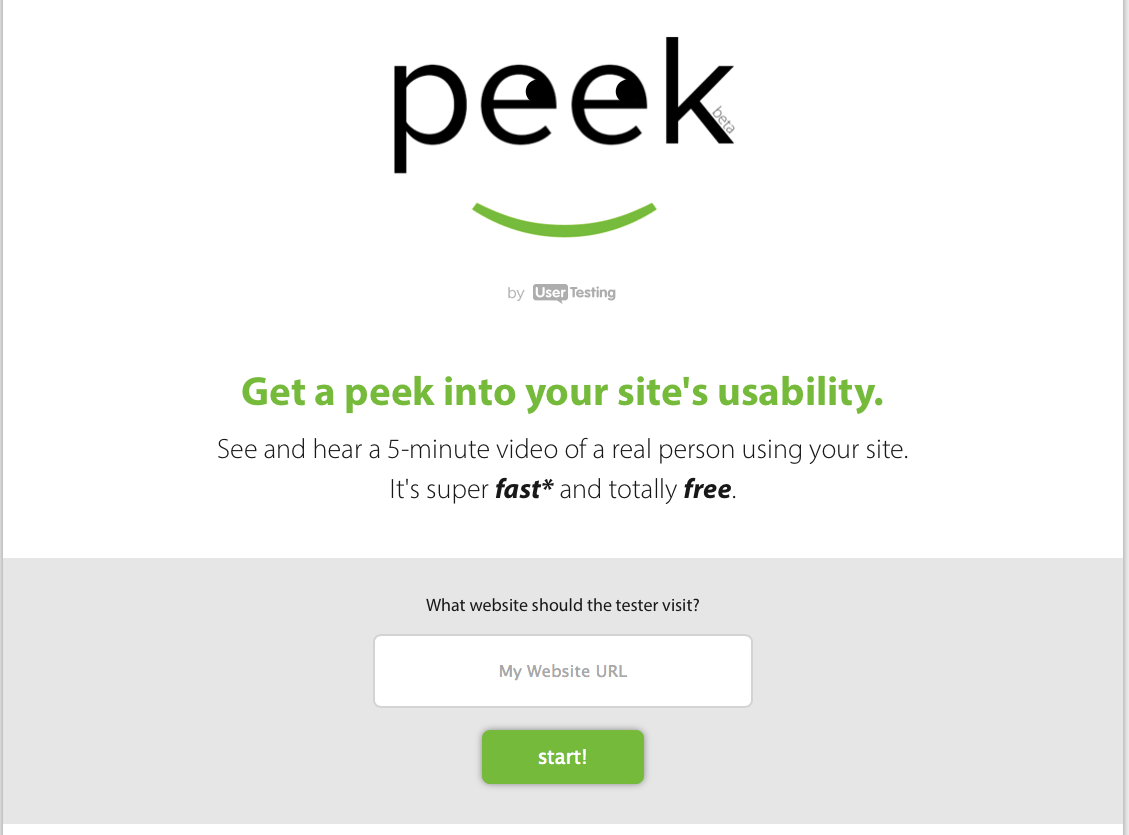
UserTesting - Peek
http://peek.usertesting.com
UserTesting offers a free "peek" of their services in a 5 minute recorded video of a user clicking around your specified website and sharing what they love and don't love about how your site navigates as well as the information available on it.  This is a great way to see how an objective general user interacts with your navigation menus, contact form, and online content so that you can see what fixes you might be able to address in order to improve your website for visitors.
peek usertesting


HubSpot - Marketing Grader
https://marketing.grader.com
HubSpot is one of my favorite free services for analyzing your site's inbound marketing strategies with SEO, Lead Generation links, Social Media reach, and other online markers of presence and accessibility.  The software is fully automated, so it's less high-touch, but it approaches your website from a similar perspective as a content web crawler like Google would. This is a great way to see what social media and marketing strategies you aren't currently implementing that you can improve upon.


Pingdom - Speed Test
http://tools.pingdom.com
Pingdom focuses on improving website speeds by identifying slow loading materials on a page as well as what loads first and last.  One of the factors in how your website ranks in search results is how fast your content can make it to the search engines, so running a speed test can help you identify the images or code that need to be cleaned up for faster loading.  Pingdom also gives you a sample of how your website stacks up against other sites that are being compared so that you know where you stand in loading times.

Try each test now and see what you can work on!  Have you seen any other awesome website tests people should run their website through?  Share in the comments!


Anne Ruthmann is an editorial & event photographer in New York City. She spent 10 years practicing marketing & management in corporate and non-profit businesses before pursuing her passion for photography in 2004 as an independent small business.  She loves helping others find creative and smart solutions to business problems.  Stay in touch on Twitter or Facebook.

Tuesday, March 11, 2014

Why Hiding Pricing Only Hurts You

What was the last major purchase you made in which you couldn't easily find a price before talking to a sales person about the product?

A home?  Real estate listings online generally list home value before you attend an open house.

A car?  Sales prices are generally listed online before you need to walk into a store.

A painting?  Art sales prices are generally listed on a sales sheet in the gallery which you can pick up before viewing the work.

A TV?  Airfare?  Vacation Package?  Rug?  Furniture?  Pair of shoes?  Phone?  Jeans?  Haircut?

…. yeah, I can't think of anything either…. so why do photographers and some other creatives hide their pricing information?

Hiding pricing hurts you in several ways:
  • clients may assume a price above their budget based on not seeing a price at all and just not contact you about their project
  • clients may assume a price in their budget based on other pricing they've seen elsewhere and assume you're a budget service only to contact you and find out that you aren't in their budget at all, which wastes both your time and the client's time
  • clients and event planners may just be doing online research and not know how to value your work against other work they're considering, and thus they throw you out of their pool entirely because they don't have enough info
  • by not providing a value for your work up front, you don't give clients advance notice about what they should plan to spend with you, which would help them prepare their finances up front and be more ready to book you on the spot before getting in touch
You don't need to give out your entire price list, but you should at least give a starting price or a price range and inform clients if you expect to prepare a custom collection for them based on their needs.  Not only will it save you and your clients a lot of headache and heartache, it will also present your business as honest, straightforward, and trustworthy - which are all desired traits for anyone looking making an investment in a quality service.

Check out Christine's previous post on this same topic for more thoughts on providing pricing: http://photolovecat.blogspot.co.uk/2009/03/on-sharing-pricing-up-front.html

Anne Ruthmann is an editorial & event photographer in New York City. She spent 10 years practicing marketing & management in corporate and non-profit businesses before pursuing her passion for photography in 2004 as an independent small business.  She loves helping others find creative and smart solutions to business problems.  Stay in touch on Twitter or Facebook.

Wednesday, February 20, 2013

Photo Lovecat Website Critique 2013

Due to the overwhelming interest last year, we ended up hosting two website critiques and the reception was great so we decided to do it again this year!

What:  Website Critique
When:  March 5th, 2013

I will be hosting the live critique along with Anne and Jennifer helping me in the chat while we view and chat about what submitted sites are doing right and what they could do better.

What we need is some submissions so this is where you take a deep breath and send your URL to us at photolovecat@gmail.com

We also need some comments here to let us know what time would be best for you?  1PM EST or 3PM EST?

PS:  We're thinking about doing a Google Hangout during WPPI for those of us who aren't going.  If you are interested, comment and let us know!  This will be more of a relaxed environment where we chat about whatever crosses our minds, be it pity parties because we can't go or celebratory parties because we're too busy to go... or gossiping about what that crazy person said on Twitter about WPPI.  We won't be there to host a real party so come to the virtual one instead we're calling IPPW.  I may even have some videos to share from past WPPI's...

Corey Ann is a wedding & lifestyle photographer from North Canton, OH. She is a mix of everything - fashionista, travel nut, deal hound, photo theft evangelist (she runs Photo Stealers) and geek rolled into one. She's had a website online since 1997 and a blog since 1999. When not plotting world domination or her next trip, she can be found reading one of the 100+ books she reads a year. Follow her on Twitter.

Monday, March 12, 2012

Website Critique Webinar

Due to popular demand, we are going to have another Website Critique Webinar this Thursday at 4PM EST! So many of you asked us to review your sites for free after our last post that we decided to go ahead and do another webinar. Are you so excited? We are! Join us just before Happy Hour to hear more tips about making your online presence the absolute BEST it can be!

This week's webinar is going to be run by Corey Ann. As a nod to one of her favorite photographers, Zack Arias, she may have a glass of bubbly in her hand as she reviews sites to take the edge off the nerves for her first ever webinar. Be kind! ;) The rest of the Lovecats will be joining in on the chat as well!

Do you want to submit your website for possible review? Send us an email and let us know!

See you Thursday!